A shoebox of family prints can look harmless sitting in a closet. Then you open it and realize what is actually inside – baby photos, holiday gatherings, wedding portraits, snapshots of relatives you can no longer ask stories from. That is where photo scanning versus flatbed scanning becomes more than a technical choice. It becomes a question of how to preserve those memories carefully, clearly, and without creating more risk for aging originals.
For many families, both methods sound similar at first. After all, each one turns a physical photo into a digital file. But the way they handle images, the time they require, and the results they produce can be very different. The best option depends on what kind of photo collection you have, what condition it is in, and how much quality and convenience matter to you.
Photo scanning versus flatbed scanning: what is the difference?
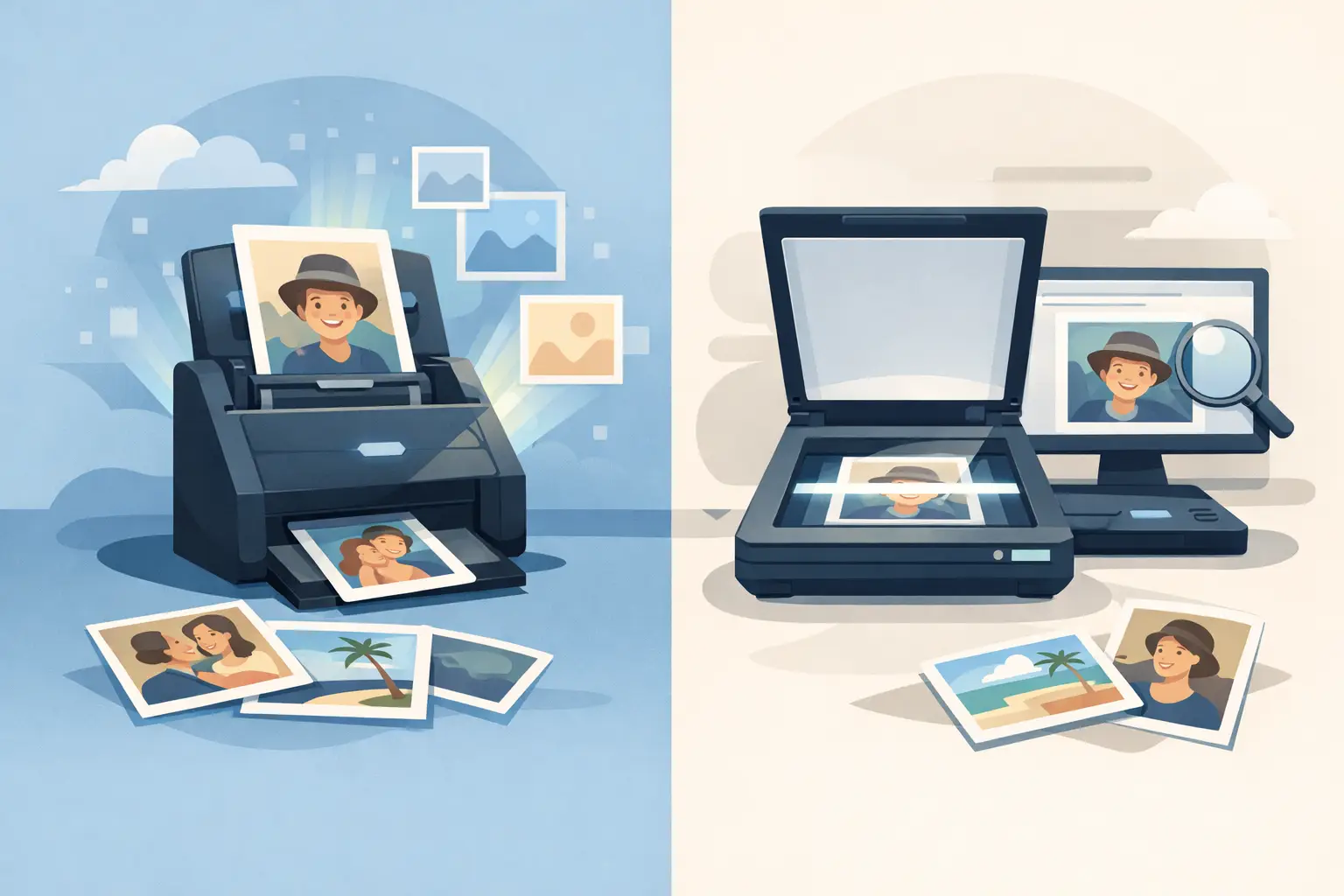
Photo scanning usually refers to feeding printed photographs through a scanner designed to process stacks of prints quickly. These machines are built for volume. If you have hundreds or thousands of standard-size photos, photo scanning can move through them far faster than placing each print one by one on a glass bed.
Flatbed scanning uses a scanner with a glass surface where each photo is laid manually. The lid closes, the image is scanned, and then the next item is placed. This process is slower, but it gives more control over positioning and often works better for delicate, oversized, mounted, or irregular items.
That difference in handling is the first thing that matters. Speed is valuable, but not every original should be fed through an automated system. Some prints are curled, torn, stuck to old album paper, or have fragile edges that need a gentler approach.
When photo scanning makes the most sense
If your goal is to digitize a large photo collection efficiently, photo scanning is often the practical winner. Standard prints in good condition can be scanned in batches, which saves a great deal of time and labor. For families who have several boxes of loose 4×6 or 5×7 prints, that speed can make the project finally feel manageable.
This method is also helpful when the priority is access. Maybe you want to share old photos with siblings, create digital backups, or organize decades of family pictures before more fading or damage occurs. In that situation, getting the collection digitized sooner matters.
A good photo scanning workflow can still produce strong image quality, especially for everyday family prints. For many households, the real benefit is not chasing museum-level perfection on every snapshot. It is making sure the images are preserved before they are lost to humidity, poor storage, or simple time.
There is a trade-off, though. Automated or high-volume photo scanning is best suited for items that are fairly uniform and stable. If the photos are bent, very old, textured, bordered in unusual ways, or printed on thicker stock, they may not be ideal candidates.
Where flatbed scanning still has the advantage
Flatbed scanning is slower, but that extra time can be worth it. When a print is fragile or valuable, individual handling often gives better protection and control. A flatbed is especially useful for older photographs, Polaroids, small wallet prints, panoramic prints, scrapbook pages, and photos that are not a standard shape or size.
It also helps when detail matters more than speed. If you plan to enlarge a portrait, preserve a historic family image, or capture the full edges and texture of an old print, flatbed scanning can be the better fit. Because the item is placed by hand, it is easier to fine-tune alignment and scan unusual originals without forcing them through a feed system.
This method can also reduce the chance of physical stress on delicate prints. That is a major point for families who are working with one-of-a-kind items. If there is only one surviving copy of a grandparent’s wedding portrait, the safest method usually matters more than the fastest one.
Quality is not just about resolution
People often compare these methods by asking which one has better quality. The honest answer is that quality depends on more than scanner specs.
Resolution matters, of course, but so do color accuracy, sharpness, dust control, cropping, and operator judgment. A fast scanner in skilled hands can produce beautiful digital files for a large family archive. A flatbed scanner can also disappoint if the settings are poor or the image is scanned carelessly.
What most families really need is a digital image that looks true to the original and holds up well for viewing, sharing, and reprinting. In many cases, both methods can get there. The better question is whether the scanning method suits the condition and value of the original photo.
If you have a collection of everyday prints from the 1980s and 1990s, photo scanning may deliver more than enough quality. If you are preserving a faded 1940s portrait with delicate edges and important tonal detail, flatbed scanning may be the wiser choice.
Handling risk matters more than people expect
The biggest mistake people make is focusing only on the final file and not on the journey the photo takes to get there.
Older photos can crack, stick, curl, or shed surface material. Some have writing on the back, deckled edges, or mounting residue. Others have spent years in Florida heat and humidity, which can make them more vulnerable than they appear. A method that works perfectly for a clean stack of recent prints may not be right for a box of aging family photos that have never been sorted.
That is why experience matters. Knowing when to batch-scan and when to switch to flatbed handling protects the originals while still keeping the project efficient. A one-size-fits-all approach can create unnecessary risk.
Cost, time, and convenience
For large collections, photo scanning is usually more cost-effective because it takes less time per image. If you are digitizing hundreds of standard prints, flatbed scanning each one manually can become slow and expensive.
But convenience should not be measured only by speed. It also includes how much sorting, preparation, and oversight the project needs. Some collections require careful review before any scanner is used. Mixed sizes, damaged prints, and album-bound photos often need a more thoughtful plan.
This is where professional guidance can save families a lot of frustration. Instead of guessing which scanner to use for every photo, it helps to have someone assess the collection and match the method to the material. That is often the difference between a rushed project and one that actually preserves what matters.
How to choose the right method for your collection
If your photos are loose, standard-size, and in decent condition, photo scanning is usually the smart place to start. It is efficient, practical, and well suited for family collections that need to be digitized at scale.
If your photos are fragile, unusually sized, mounted, or especially meaningful, flatbed scanning is often the safer choice. It gives more control and reduces handling stress for originals that cannot be replaced.
Many real-world projects need both. That is the part people often miss. A single family archive may include stacks of recent prints that are perfect for photo scanning, along with a handful of heirloom images that deserve flatbed treatment. The best preservation work does not force every item into the same process.
At HB Media Solutions, that kind of judgment is part of protecting the memories, not just processing the media. Families are not dropping off ordinary paperwork. They are trusting someone with birthdays, reunions, and faces they never want to lose.
Photo scanning versus flatbed scanning for peace of mind
When people ask about photo scanning versus flatbed scanning, they are often really asking something simpler: What is the safest and smartest way to keep these photos alive?
The answer starts with your collection. Volume favors photo scanning. Fragility favors flatbed scanning. A mixed archive usually needs a mixed approach. What matters most is choosing a process that respects both the image quality and the original item in your hands.
If you have been putting off digitizing your photos because the choices feel confusing, that hesitation is understandable. Old pictures carry emotional weight, and once they are damaged, there is no easy redo. The right scanning method should make the process feel less risky, not more. Your family photos have already done their job for decades. Now they deserve careful preservation so the next generation can see them just as clearly.