A shoebox of old cassette tapes can hold more than audio. It might be a parent’s voice, a child’s first words, interviews with relatives, church messages, or family stories nobody ever wrote down. If you’re wondering how to save cassette voice recordings, the hard truth is simple: magnetic tape does not wait. It stretches, sheds, warps, and slowly becomes harder to play back safely.
The good news is that most cassette voice recordings can still be preserved if you handle them carefully and act before damage gets worse. The right approach depends on the condition of the tape, the kind of playback equipment available, and how much risk you want to take with something that may be impossible to replace.
Why cassette voice recordings are at risk
Cassette tapes were never designed to last forever. The sound is stored on a magnetic coating attached to a thin plastic base. Over time, heat, humidity, dust, and repeated playback can all wear that surface down. Even tapes that were stored in a closet and rarely used can still degrade simply because of age.
Voice recordings are especially vulnerable because many were made on small consumer recorders, microcassette devices, or portable units that did not produce the strongest original recording. That means the signal may already be faint. If the tape is played on a machine with dirty heads, weak belts, or poor alignment, you can lose clarity fast or even damage the tape during playback.
This is why waiting for the “right time” often backfires. The best time to preserve old cassette recordings is before they start squealing, sticking, or breaking.
How to save cassette voice recordings without causing damage
Start by resisting the urge to put the tape into the first player you find online or in the garage. Old tape machines often have worn pinch rollers, dried belts, or dirty capstans. A tape that survived 30 years in storage can still be damaged in minutes by a machine that pulls unevenly.
First, inspect the cassette shell. Look for cracks, loose screws, warped plastic, mold, missing pressure pads, or tape that appears twisted or slack. If the tape looks tightly wound and the shell is intact, that is a good sign. If you see severe wrinkles, sticky residue, or detached tape leader, stop there. That is a restoration issue, not a simple transfer job.
If the cassette looks stable, the next step is choosing between a do-it-yourself transfer and professional digitization. Both can work. The difference usually comes down to tape condition, your comfort level, and how much the recording matters.
Option 1: Transfer the tape yourself
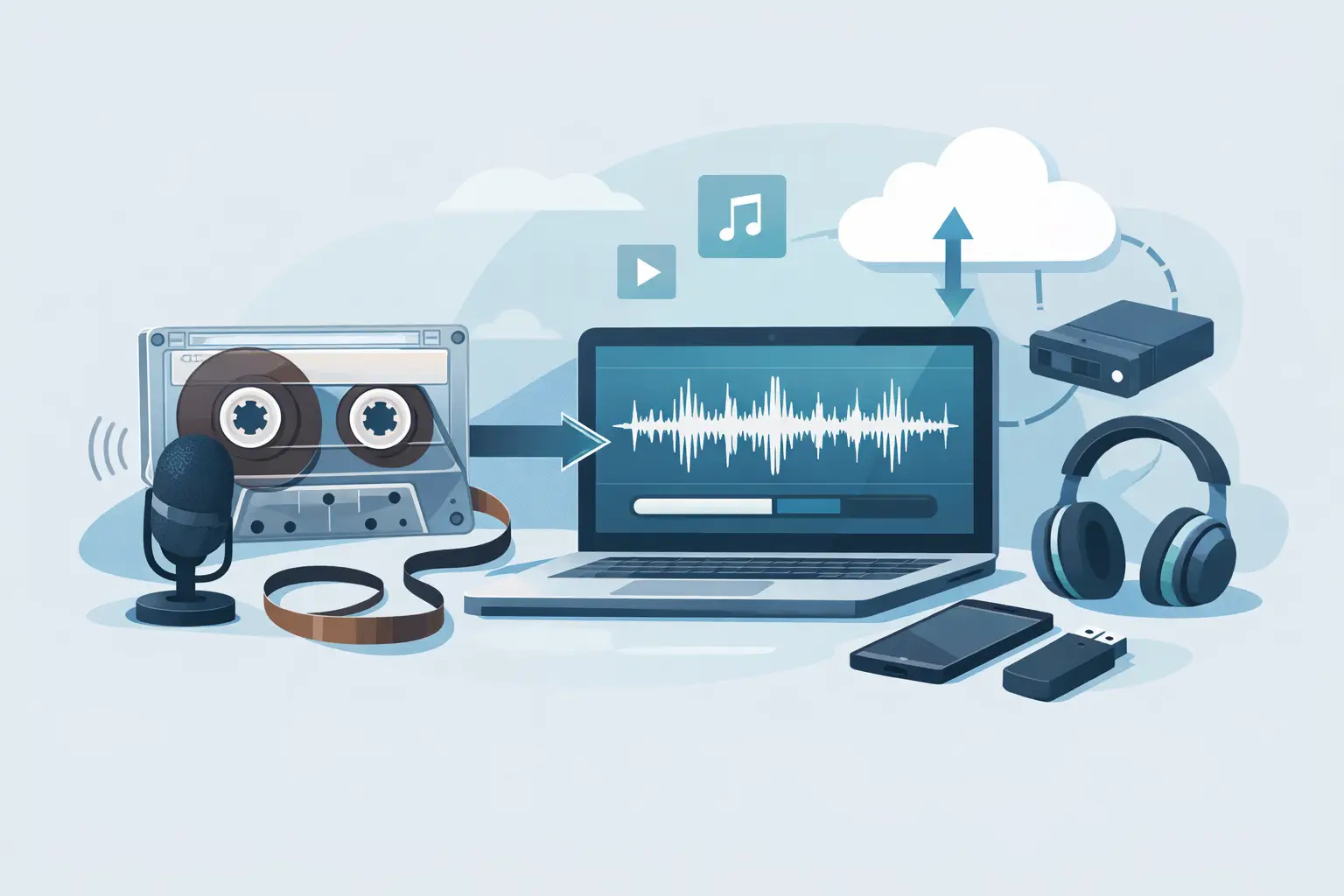
A home transfer can be reasonable when the cassette is in good condition and the content is not unusually fragile. You will need a working cassette deck or voice recorder that matches the tape format, plus a way to capture the audio into a computer. For standard compact cassettes, a well-maintained deck with line-out connections will usually give better results than a cheap USB cassette player. For microcassettes or mini-cassettes, you need the correct playback machine for that exact format.
You then connect the player to an audio interface or compatible input, record the playback in real time, and save the file in a digital format such as WAV or MP3. WAV is the better preservation choice because it is uncompressed. MP3 is smaller and easier to share, but it throws away some audio data.
The trade-off is that DIY transfer is only as good as your equipment and setup. If the tape runs too fast, too slow, or with background hum, those problems become part of the digital file. You can improve some issues later with software, but you cannot fully restore detail that was never captured properly.
Option 2: Use a professional transfer service
If the cassette holds irreplaceable family memories, professional transfer is often the safer path. This is especially true for damaged, rare, or poor-quality recordings. A professional service can match the proper playback equipment, clean and inspect the tape, correct certain tracking and speed issues, and capture the audio with more consistency than most home setups.
This matters a great deal with spoken-word recordings. Voices are personal. A little more clarity can mean finally understanding a grandparent’s story or recognizing a voice you have not heard in decades. A careful transfer also reduces the risk of the tape being harmed during playback.
For families in South Florida, working with a local, established provider can add peace of mind because you know where your originals are and who is handling them. Companies like HB Media Solutions build trust by combining experienced transfer work with personal service, which matters when the tape in your hand is one of a kind.
What format should you save the audio in?
If your goal is long-term preservation, ask for a high-quality master file first. WAV is usually the best choice for that purpose because it preserves the full captured signal without compression. From that master, you can create listening copies in MP3 or another convenient format for phones, email, or family sharing.
It is smart to keep more than one copy. Save the master file on your computer, back it up to an external hard drive, and keep another copy in a cloud account if you use one. One digital copy is better than none, but three copies in different places is much safer.
If the recordings are labeled, carry that information into the file names. A file called Dad Interview 1989 Side A is much more useful than Track001. If you know the people, place, or occasion, add that too. Preservation is not only about saving the sound. It is also about keeping the context that makes it meaningful.
Common problems with old cassette voice tapes
Some cassette issues are minor. Others are warning signs that playback should stop right away. A tape that sounds muffled may simply come from an old recording with limited quality. But squealing, dragging, or stopping during playback can point to friction, binder problems, or a failing shell.
Broken tape, detached leader, shell damage, and mold usually require hands-on repair before transfer. Poor audio can sometimes improve with azimuth adjustment, better playback alignment, or careful level correction during capture. But not every recording can be made to sound “like new.” Sometimes the goal is not perfection. It is saving the voice clearly enough that it can still be heard and kept.
That is an important expectation to have. Preservation and restoration are related, but they are not the same thing. Saving the recording means capturing what remains as safely and accurately as possible. Restoration can then help reduce hiss, balance volume, or improve intelligibility, but aggressive cleanup can also remove natural speech detail. It depends on the recording and what you want from it.
A few storage steps that still matter before transfer
If you are not sending the tapes out immediately, store them upright in a cool, dry place away from direct sunlight. Avoid garages, attics, and cars, especially in Florida heat. Keep them in their cases if possible, and do not stack them loosely where the shells can crack.
Do not try home cleaning with cotton swabs, alcohol, or by opening the cassette unless you know exactly what you are doing. Good intentions can create permanent damage. The safer move is basic protection, gentle handling, and quick action.
When it makes sense to get help
If the tape contains a loved one’s voice, legal or oral history material, or anything you cannot recreate, there is real value in not experimenting. The same goes for microcassettes, answer machine tapes, or recordings made on unusual devices. Format matching alone can be a challenge, and the longer you spend hunting for equipment, the older the tape gets.
A professional transfer service also saves time. Instead of troubleshooting cables, software settings, noisy playback, and file exports, you can hand over the tape and get back usable digital files with your originals returned. For many families, that simplicity is part of the value.
Saving old voice recordings is really about protecting a human connection. The sound may be imperfect. There may be hiss, room noise, or a shaky handheld recorder in the background. None of that reduces what matters. Once those voices are preserved digitally, they become easier to hear, copy, share, and keep close for the next generation.